Global reliable toilet paper manufacturer & wet tissue supplier with over 15 years OEM&ODM experience



Let's talk about papermaking from scratch: How is toilet paper made?
2025-12-26
There are countless paper products, and household paper products include toilet paper, facial tissue, handkerchiefs, napkins, kitchen paper towels, hand towels, and absorbent liners for sanitary products. Toilet paper accounts for approximately 45%-55% of the global market share of household paper products, making it the main household paper product.
From raw materials to the production of a qualified roll of toilet paper, the following basic processes are usually involved:
Phase One: Pulping - Converting raw materials into pulp
This is the process of converting solid raw materials into a fiber suspension.
Virgin wood pulp: Primarily comes from a mixture of softwood (such as pine, providing strength) and hardwood (such as eucalyptus and birch, providing softness). The wood undergoes debarking and chipping.
Recycled paper pulp (recycled pulp): Recycled office paper, printed materials, etc., require strict screening and deinking treatment.
Pulp board (commercial pulp): Dried pulp boards purchased from outside paper mills are a common raw material and directly enter the pulping stage.
Pulping and purification:
Pulping: In a large pulper (hydrapulper), pulp boards or wood chips are mixed with water and chemicals (such as deinking agents), broken down by rotating impellers, and the fibers are separated to form primary pulp.
Screening and purification: The pulp is cleaned in multiple stages through various screens (to remove large impurities such as plastic pieces and glue particles) and centrifugal purifiers (to remove heavy impurities such as sand and metal shavings) to ensure fiber purity.
Phase Two: Papermaking - Forming and drying the pulp
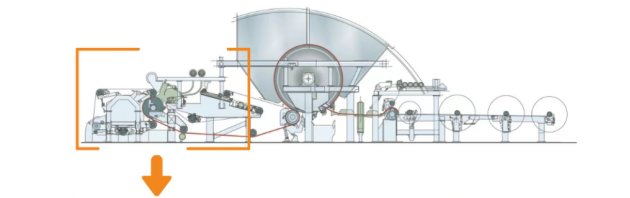
This is the crucial stage where toilet paper forms its unique soft and fluffy structure, usually carried out on large, high-speed tissue machines.
Flowing and forming:
The purified dilute pulp is evenly and smoothly sprayed onto the forming wire (polyester mesh) through a headbox. At this point, the pulp concentration is approximately 0.1-1%.
Forming and dewatering:
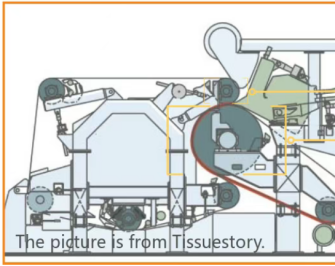
The pulp runs on the forming wire, and most of the water is removed through gravity, vacuum suction boxes, etc., causing the fibers to interweave randomly, forming a wet paper web. Toilet paper usually uses a "crescent former," where the paper web is formed in the "crescent" shaped area between the forming wire and a large drying cylinder, which helps to achieve better softness. Pressing (Special Process for Toilet Paper):
Unlike traditional paper, toilet paper production specifically controls the dewatering process during pressing, retaining a higher moisture content (approximately 60-70%). This is to prepare for the subsequent creping process; excessive dryness would prevent proper creping.
Drying and Creping - The Core Process:
The wet paper web is tightly pressed onto a large Yankee dryer cylinder with a very high surface temperature (usually over 100°C).
It is rapidly dried on the cylinder to approximately 95% dryness.
At the end of the drying process, a steel blade called a "creping blade" scrapes the paper web at a specific angle. This scraping action instantly shortens the paper web, creating tiny wrinkles.
Creping is the soul of toilet paper: it directly gives toilet paper its softness, bulkiness, absorbency, and appropriate stretchability. The creping rate (the proportion by which the paper is shortened) is a key parameter for controlling product quality.
Third Stage: Post-Processing - Transforming Large Rolls into Finished Products
Winding and Rewinding:
The creped toilet paper is wound into a huge parent roll.
The parent roll is sent to a rewinding machine, where it is precisely cut and rewound according to the finished product specifications (such as the width, diameter, and perforation spacing of the toilet paper roll). Perforation, embossing (to increase aesthetics and thickness), and finishing operations are also completed, resulting in the toilet paper rolls seen in supermarkets.
Packaging and Warehousing:
An automated packaging line wraps single or multiple rolls of toilet paper in plastic film, packs them into cardboard boxes, labels them, and sends them to the warehouse for shipment.
As ordinary consumers, the most intuitive aspect we notice when using toilet paper is its softness. However, the softness of toilet paper is related to numerous factors. On the one hand, it depends on the selection and design of process parameters in the forming, pressing, drying, and creping stages of the toilet paper machine; on the other hand, it is closely related to the pulp ratio (addition of raw materials), the use of additives, and moisture control.
LANGQIAO BIOTECHNOLOGY brand has equipped itself with advanced production machinery and innovative manufacturing processes, employing advanced environmentally friendly and safe technologies to ensure the high standards and quality of every product. We strive to produce newer and better series of household paper products for our consumers. To meet the needs of our customers, the factory has established a comprehensive product quality management system and is committed to timely delivery, reasonable pricing, and excellent service.
ReviewsNumber of comments: {{ page.total }}
I want to comment?
{{item.nickname ? (item.nickname.slice(0, 2) + '*****') : item.source === 1 ? 'mall buyer' : '--'}}
{{item.comment_time}}
Review in the {{item.country}}
Reviews
Merchant
{{replyItem.nickname ? (replyItem.nickname.slice(0, 2) + '*****') : replyItem.source === 1 ? 'mall buyer' : '--'}}
{{replyItem.parent_nickname ? (replyItem.parent_nickname.slice(0, 2) + '*****') : '--'}}
{{replyItem.is_merchant_reply === 1 ? replyItem.reply_time : replyItem.comment_time}}
Review in the {{replyItem.country}}
Reviews

No customer reviews
recommended for you
Get in touch with us
Zibo Langqiao Biotechnology Co., Ltd. is an enterprise focusing on the export of high-end household paper. We are a professional toilet paper bulk manufacturer of disposable adult diapers, under pads, sanitary napkins, and pet urine pads, etc.
QUICK LINKS
PRODUCTS
CONTACT US
Email: lynn@cnlangqiao.cn
Phone: +86 19862230536
Phone: +86 19862230536
WhatsApp: +86 19862230536
Address: Room 1406, Zhongde Building, No. 222, Renmin West Road, Zhangdian District, Zibo City, Shandong Province, China
Address: Room 1406, Zhongde Building, No. 222, Renmin West Road, Zhangdian District, Zibo City, Shandong Province, China
social media
Copyright © 2026 Zibo Langqiao Biotechnology Co., Ltd. - www.langqiaohygiene.com |Sitemap